
How Helium and XNET are solving telecom's infrastructure crisis?
The Network Problem Carriers Can’t Fix Alone

Part 1: Why does the mobile internet still collapse when you need it most?
Have you ever been stuck in a stadium, a concert, or a packed conference hall with your phone in hand, showing full signal bars and yet nothing works?
Messages don’t send.
Payments fail.
Maps freeze.
Calls drop the moment they connect.
You refresh WhatsApp. You toggle airplane mode. You blame your carrier. Someone next to you says, “My network is trash too.” Someone else says, “5G is a scam.”
This isn’t a rare case. It’s become quite common in the USA today.
At music festivals, parents can’t reach their kids. At sports stadiums, fans can’t load tickets or place food orders. At tech conferences, ironically, the internet collapses right when thousands of people are trying to post, or make UPI payments at the same time.
Even mainstream outlets like Guardian and others have repeatedly documented the same complaint from users.
Why isn’t this actually a “bad carrier” problem?
It’s tempting to blame telecom companies. But mobile networks don’t fail in crowds because carriers are lazy or underinvested.
In fact, telecom operators have spent hundreds of billions of dollars over the years on infrastructure, buying spectrum licenses, building towers, laying fiber across cities, and upgrading networks.
The real problem is in physics that almost no one talks about.
As mobile technology has upgraded from 3G to 4G to 5G the industry has steadily moved to higher frequency spectrum bands to deliver faster data speeds and lower latency. Networks that once relied heavily on lower bands (900 MHz) now increasingly operate in ranges like 3300–3600 MHz.
But the tradeoff with this is, the higher the frequency of a radio signal, the shorter its wavelength. Shorter wavelengths don’t travel as far, and they’re far more fragile. They get weakened or completely blocked by everyday obstacles: walls, glass, high rise buildings, trees, rain, or even congested in huge crowds of people.
Older, lower-frequency signals (like the ~900 MHz bands used in 2G and early 3G) could bend around buildings and hills through a phenomenon called diffraction. That’s why your 4G or 5G signal often collapses the moment you walk deeper into a mall, enter a basement, or step into an elevator even though your phone still shows signal bars. This isn’t a software bug. It’s how radio waves behave.
And this is where the real infrastructure challenge begins.
To compensate for the shorter reach of higher-frequency networks, carriers need many more cell sites, especially in dense urban areas, high-rise zones, stadiums, campuses, and busy roads. As a rough rule of thumb: Moving to higher frequencies often requires 10x to 100x more cell density to maintain consistent coverage. That doesn’t mean just more big towers miles apart. It means smaller cells placed much closer together.
So carriers began densifying their networks. They deployed small cells on streetlights, utility poles, rooftops, traffic signals, and building walls. They installed Distributed Antenna Systems (DAS) inside stadiums, airports, offices, and other venues where thousands of people gather in one place. Technically, these solutions worked. Economically, they were brutal.
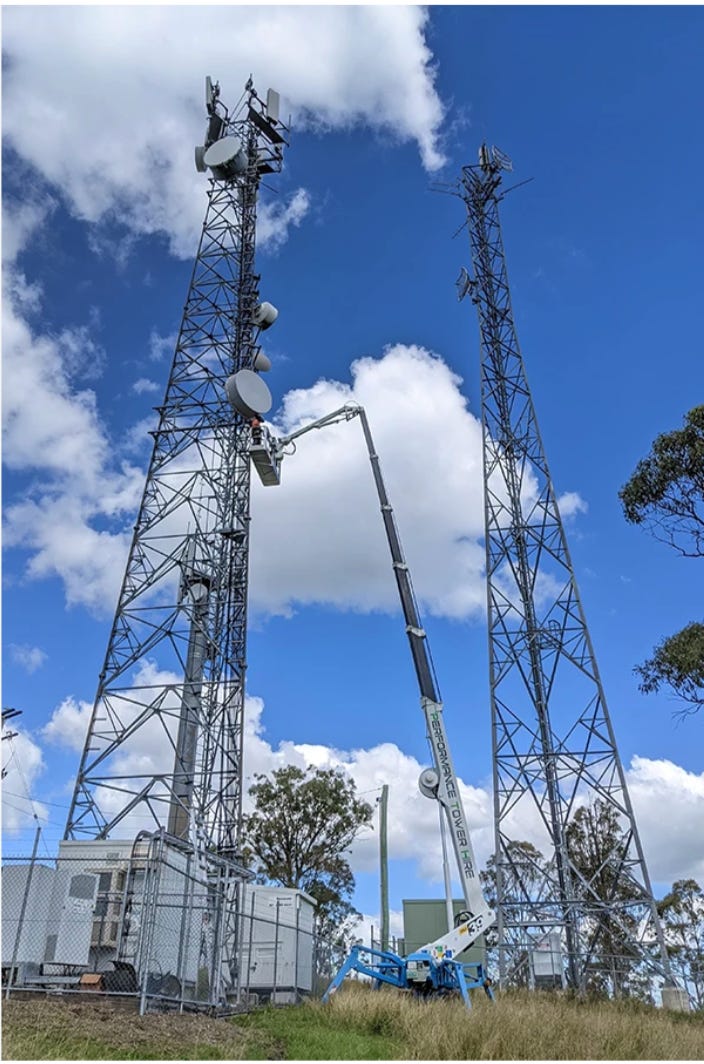
Every new tower or cell site comes with heavy costs: equipment, installation, power, and fiber connectivity. A single site can easily cost $250,000 or more to set up.
But cost is only half the problem. There’s also:
site planning
zoning approvals
negotiations with local authorities
resistance from residents who don’t want infrastructure near their homes
Most neighbourhoods push back. Zoning laws drag on. Permissions take months, sometimes years. At some point, managing towers stopped feeling like a telecom problem and started feeling like a real-estate business.
To reduce this burden, carriers began outsourcing physical infrastructure to specialised tower management companies like Crown Castle and American Tower.
These companies:
built and owned towers
owned or leased the land
handled zoning and permits
maintained the physical sites
Carriers, in turn, leased space on these towers instead of owning them outright. This was more efficient than every carrier building its own towers. A single tower could now host multiple carriers at the same time, reducing duplication and speeding up deployment.
Today, the U.S. has 500,000+ cell towers, deployed by a mix of tower companies and carriers. And yet, even with this massive footprint, it still isn’t enough for reliable high-frequency coverage everywhere people actually use their phones.
Leasing towers reduced complexity for carriers, but it didn’t change the fundamentals. Tower rents are high, often tens of thousands of dollars per site per year. Every 8-10 years, new generations of network hardware require upgrades, renegotiations, and fresh costs. Meanwhile, the economics stay stubborn:
capital and operating costs keep rising
revenue per user stays relatively flat
So even after billions spent, networks still fail to meet the current data demands especially in areas which are crowded. That’s when they started exploring solutions using other internet connectivity channels.
Part 2: How broadband became the backbone of the mobile internet?
By around 2010, two trends began accelerating at the same time.
Smartphones led by Apple and Android started becoming mainstream. And fixed broadband/WiFi, especially in the U.S., was expanding fast. 42% of U.S. adults had broadband at home in early 2006 to about 72.4% by 2012. This overlap is crucial. Broadband didn’t spread because of smartphones. And it didn’t spread because of the internet either. It spread because cable TV had already solved last-mile connectivity decades earlier. Long before mobile data exploded, cables and wires were already running into homes and buildings originally to deliver television. When internet access arrived, it simply integrated on top of that same infrastructure.
Another important factor to consider is that broadband and Wi-Fi operate on unlicensed spectrum. That meant cable providers, unlike telecom carriers, did not have to spend billions of dollars competing in spectrum auctions or navigate years of regulatory friction before expanding capacity.
As a result, broadband networks optimized for cheap, dense, indoor capacity while mobile networks remained constrained by licensed spectrum economics designed for wide-area coverage, not indoor data demand. By the time smartphone usage started rising sharply, carriers began noticing a pattern they couldn’t ignore. Three things stood out:
Mobile data traffic was growing faster than tower capacity.
Most usage was happening indoors, where cellular struggled the most.
Users already had broadband at home, offices, malls, and campuses.
In other words, the internet already worked, just not over cellular at scale.
This led to a simple but uncomfortable question:
Why are we forcing indoor traffic through an expensive cellular spectrum when another pipe already exists?
That question is where the idea of carrier offload truly begins. Not as a product. Not as a decentralization movement. But as a pragmatic response to current conditions. Carrier offload involves easing congestion on cellular towers by shifting excess mobile data traffic onto existing Wi-Fi and fixed broadband networks, especially in high-density indoor environments without consumer realizing it. In 2008, AT&T made one of the most significant early moves in Wi-Fi offload strategy when it acquired Wayport, Inc., a major U.S. Wi-Fi hotspot operator.
At first glance, offloading traffic to Wi-Fi looks seamless. If cellular is congested, push traffic to broadband. But for telecom operators, this wasn’t trivial at all. Carriers faced several hard problems:
They didn’t know who the user was.
They couldn’t enforce policies or controls.
They couldn’t manage billing or subscriptions.
They couldn’t guarantee quality of service.
In a congested situation, how do you decide:
Should a message go through before a video stream?
Who gets throttled, and who doesn’t?
Without identity, control, and policy, Wi-Fi was effectively outside the native telecom system. So even though offload was widely being adopted, it wasn’t operationally feasible, automatic and scalable until 2012 when the Wi-Fi Alliance introduced Passpoint (Hotspot 2.0). It allowed carriers to authenticate users automatically using SIM credentials, integrate with carrier billing systems, enforce policies and prioritization of data transfer (message over video stream). Your phone could now connect automatically, just like it does when roaming between cellular towers. This is the moment when offload became real, and carrier grade.
Carriers integrate with broadband and Wi-Fi networks often operated by ISPs (Internet Service Providers) and treat them as an extension of their own network. From the user’s perspective, nothing changes. From the network’s perspective, pressure is relieved. This is why today, at airports, malls, offices, or campuses, your phone often switches networks without you noticing.
“But won’t Wi-Fi get congested too?”
You might be wondering at this point: if cellular networks get congested, why doesn’t Wi-Fi get congested in the same way?
The answer lies in how Wi-Fi and cellular scale differently. Wi-Fi operates at very short range. Signals typically travel tens of meters and are easily blocked by walls and floors. This limitation is the primary reason you need multiple routers in offices and homes. But it turns out to be a strength because Wi-Fi covers such small areas - the same frequencies can be reused millions of times across a city and congestion stays local, not city-wide. If one office Wi-Fi is overloaded, it doesn’t affect the building next door. And congestion is easy to fix: add more routers, add more fiber (wires to your home/building) or split users across access points (routers). But cellular doesn’t have this luxury. When a cellular sector congests - thousands of users are affected at once and fixes require new sites, permits, hardware. So while Wi-Fi congestion is localized and manageable, cellular congestion is broad and expensive. That asymmetry is the key reason offload works.
Part 3: What offload looks like in practice today?
Offload worked. It reduced congestion. It improved indoor performance. It delayed the need for endless tower densification.
But it also introduced a constraint that carriers couldn’t escape.
Offload only works where commercial agreements exist with Wi-Fi and broadband providers. Unlike cellular towers which form a shared, national layer, Wi-Fi offload is fragmented. It is owned, operated, and maintained by different broadband providers across a city. Whether traffic can be offloaded or not depends entirely on who owns the network in that location, and whether a commercial agreement exists.
That reality shaped how offload evolved in practice. Today, U.S. carriers rely on four broad categories of Wi-Fi offload infrastructure.
Carrier-owned Wi-Fi.
Some carriers operate their own public Wi-Fi layers in limited areas. These are tightly controlled, carrier-managed networks, often deployed where economics make sense. A common example is AT&T’s “attwifi” public hotspot layer.
Neutral-host venue operators.
In high-traffic indoor environments - airports, stadiums, hotels, military bases - specialized operators build and manage Wi-Fi, DAS, and small-cell systems on behalf of venues. Boingo is a well-known example, powering connectivity across large public and semi-public spaces.
Municipal or public Wi-Fi.
Some cities operate free public Wi-Fi networks that carriers can integrate into their offload strategy via PassPoint. LinkNYC is a notable example, where AT&T subscribers offload traffic onto the city’s Wi-Fi layer.
Cable MVNOs.
Cable companies like Comcast and Charter operate massive Wi-Fi hotspot networks. Through MVNO* agreements, they rely on a carrier’s cellular network for coverage but offload traffic onto their own Wi-Fi infrastructure. But these Wi-Fi networks are not available to the carrier’s direct subscribers. Examples include Xfinity (Comcast) and Spectrum (Charter) have commercial agreement with Verizon.
Exhibit: Telecom roles (quick guide)
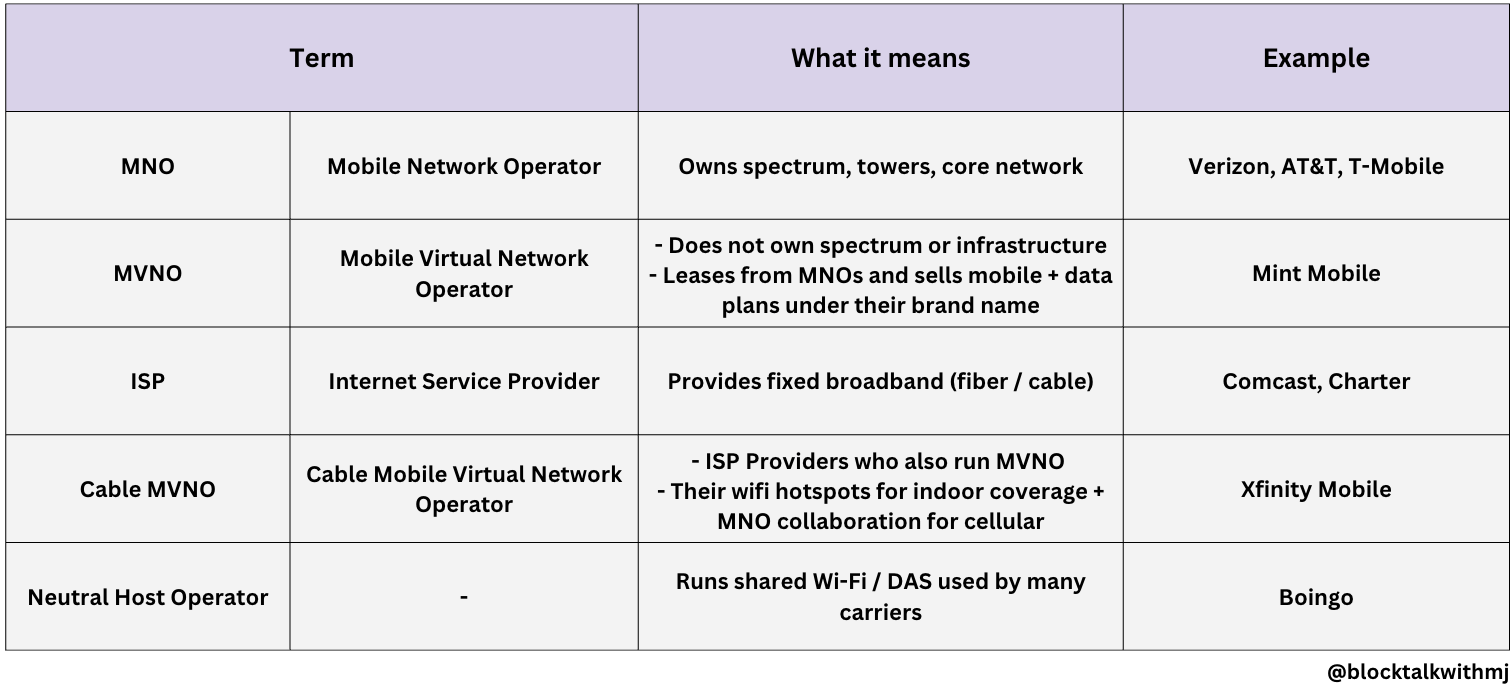
Exhibit: US Carrier Wi-Fi Offload Partnerships
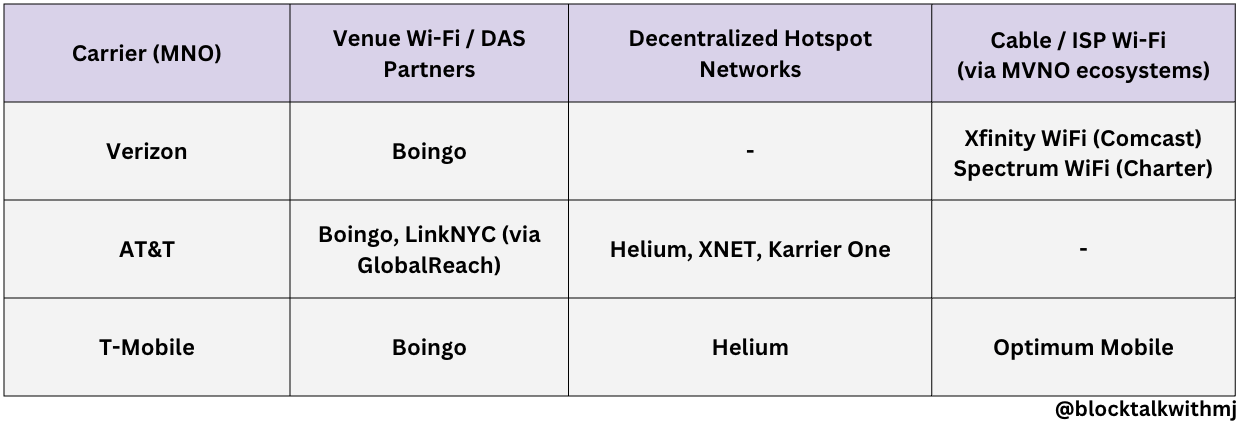
One of the biggest limitations of offload today is fragmentation. Coverage quality varies not because of radio physics alone, but because of commercial boundaries. A carrier may perform extremely well in one neighborhood and poorly just a few blocks away, simply because offload agreements differ across venues, municipalities, and broadband providers.
Wi-Fi offload remains localized and permissioned and every new location requires a separate partnership, a separate integration, and a separate economic negotiation. This made offloading difficult to scale uniformly.
As mobile data demand continued to rise, this fragmentation exposed a clear gap: carriers needed a more uniform, easily onboardable infrastructure layer, one that could extend coverage nationally without renegotiating access city by city or venue by venue. This gap set the stage for a new class of decentralized hotspot networks, including Helium, XNET, and Karrier One.
Part 4: How DeWi networks address the offload fragmentation problem?
The defining difference between these decentralized wireless networks and earlier offload models is how supply is onboarded.Traditional Wi-Fi offload scales through contracts. DeWi scales through participation. Instead of a carrier negotiating access with a venue owner, a municipality, or a broadband provider, DeWi networks allow any broadband-connected location to contribute offload capacity directly.
Hotspots are installed by individuals or businesses, integrated into a shared network/community of miners and in return these miners earn a token ($HNT or $XNET) based on network participation and, increasingly, on actual data transfer. The incentives are calculated in proportion to the bandwidth actually utilized by the offload program and can be easily traded in markets or converted to fiat. Hotspots that sit in low-traffic areas naturally earn less while the ones placed in dense residential or commercial zones see higher utilization and incentives. This market-driven approach addresses the fragmentation problem nationally, eliminating the need for carriers to negotiate agreements city by city or venue by venue.
But DeWi networks offer more than just coverage flexibility. They also fundamentally change the economics. Traditional offload required carriers to pay fixed costs for every small cell installation, regardless of whether it was actually being used. With DeWi, carriers pay only for bandwidth consumed. No traffic, no cost. This shifts infrastructure from a capital expense (capex) to a variable operating expense (opex), making offload far more economically efficient.
Today, several DeWi networks are actively competing to solve this problem, with Helium and XNET leading the space, each taking a distinctly different strategic approach.
Helium is one of the early pioneers in the DeWi sector, launching its IoT network in 2019 as blockchain and crypto adoption accelerated. But in 2022, the company made a strategic pivot, announcing a partnership with T-Mobile and plans to enter the telecom sector with Helium Mobile. Around the same time, XNET also announced its intention to build in this space, setting up what would become a competitive race to solve carrier offload.
While both networks fundamentally address the same problem, their approaches differ significantly.
Helium positions itself as both a potential offload partner for carriers and an MVNO (Mobile Virtual Network Operator) with its own mobile plans. Helium Mobile subscribers use Helium’s Wi-Fi hotspots for indoor coverage and roam onto T-Mobile’s cellular network when Wi-Fi isn’t available. This dual model gives Helium flexibility, it can serve its own customers while also offloading traffic for major carriers like AT&T and T-Mobile.
In contrast, XNET exclusively pursues B2B carrier offload in high-value commercial locations. There are no consumer plans, no branding on the user side. XNET operates as pure infrastructure, invisible to end users. When AT&T partnered with XNET in 2024, they quietly ran seven months of production traffic before making a public announcement, validating performance and reliability in real-world conditions before committing publicly.
Different strategies for bootstrapping supply
Helium adopted a more open, permissionless approach. Any individual, Wi-Fi operator, or venue owner can purchase and set up a Helium hotspot, whether indoors or outdoors. Users can also repurpose their existing Wi-Fi equipment if it supports Passpoint (Hotspot 2.0), making it directly usable for offload without buying new hardware. This openness accelerated deployment. Today, over 120,000 Helium mobile hotspots are live across the U.S., with significant expansion into Mexico and Brazil as well.
XNET, by contrast, took a more curated, quality-first approach. Rather than allowing anyone to deploy anywhere, XNET restricts installations to high-footfall venues like airports, stadiums, shopping malls, hotels, and conference centers, places where carrier networks struggle most and where offload delivers the highest value per site. Currently, about 1,100 XNET nodes are active across 1,300+ commercial locations.
Pricing and partnerships
Initially, to attract interest from mobile network operators, Helium positioned itself aggressively on price. The company charges $0.50 per GB of offloaded traffic—a rate designed not just to solve coverage and capacity problems, but to undercut traditional small cell and DAS costs. XNET, on the other hand, has not publicly disclosed its per-GB pricing, preferring to negotiate commercial terms privately with enterprise partners.
Helium’s expansion into Mexico is particularly telling. The company partnered with Telefónica/Movistar, which has long struggled with profitability in Mexico and other Latin American markets due to low ARPU (Average Revenue Per User) and relatively high capital expenditure. Telefónica even sold its Argentina operations but chose to work with Helium in Mexico, using Helium’s low-cost, community-deployed model to densify coverage without bearing the full infrastructure cost.
Helium’s offload program was activated in June 2024, and the network has been transferring over 80 TB of data daily. While XNET does not publicly disclose exact volumes of data offloaded, the network has reported a steady increase in offload sessions over time, indicating growing real-world usage. Today, both networks work with top-tier U.S. carriers. Helium has agreements with T-Mobile (no commercial agreement), AT&T, and Telefónica. XNET works with AT&T and has indicated partnerships with additional MNOs and MVNOs, though details remain undisclosed.
Product-market fit, but challenges remain
The fact that both networks are being adopted by major carriers is a significant achievement. Mobile network operators are notoriously brand-conscious, and offloading traffic means putting their reputation directly in the hands of third-party infrastructure. For carriers to trust DeWi networks at scale, the quality must match or exceed traditional solutions.
Both Helium and XNET have proven product-market fit. But long-term success depends on more than just coverage and cost. It depends on hardware quality and reliability, seamless handoff between cellular and Wi-Fi without user disruption, core network integration: SIM authentication, billing, QoS (Quality of Service), and traffic prioritization during congestion and community satisfaction and sustainability.
Since these are bootstrapped networks, they must ensure that hotspot operators remain satisfied with the rewards they earn. Operators need to recover hardware costs and earn enough monthly income to justify maintaining their equipment.
Initially, both networks relied heavily on Proof-of-Coverage (PoC) rewards, incentives for simply being online and providing coverage. But as demand for actual offload grew, both shifted toward bandwidth-based rewards, where operators earn primarily from data transferred, not just from being active. This shift has created friction in the community.
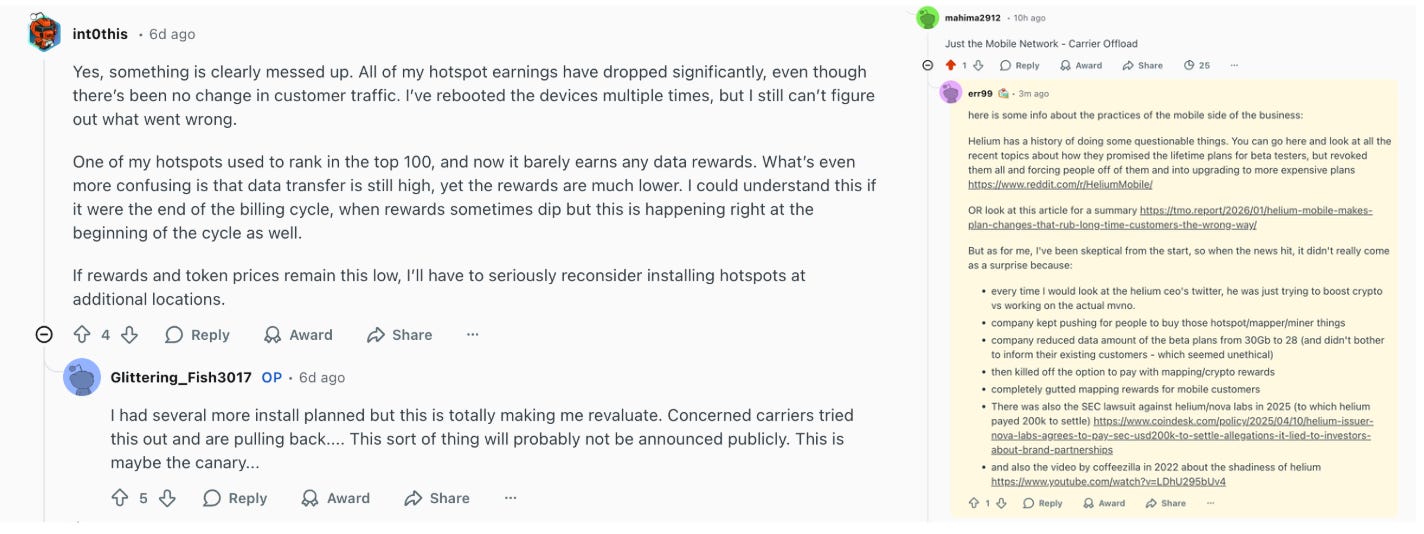
As is common with DePIN (Decentralized Physical Infrastructure Networks), early participants get used to high token rewards. When those rewards decline, either because PoC incentives are reduced or because traffic patterns fluctuate, some operators become dissatisfied. Helium, in particular, has faced complaints on Reddit and Discord from hotspot owners who report that despite serving traffic, their rewards don’t reflect usage, or that their areas simply don’t see consistent offload activity. If dissatisfaction grows and operators start de-installing hardware, carriers relying on that coverage could face sudden service degradation, which is a long-term risk.
Perhaps the most critical limitation both networks face is this: neither Helium nor XNET controls the backhaul.
Both rely on existing broadband connections, usually residential or commercial internet service provided by ISPs to route offloaded traffic. If a broadband connection fails, if latency spikes, or if quality degrades, the DeWi network has no direct control. The hotspot goes offline or performs poorly, and there’s little the network operator can do independently to fix it.
This dependency creates a fundamental constraint. Even though Helium and XNET can track coverage, usage, and quality metrics through their platforms, they can’t guarantee carrier-grade reliability the way a traditional DAS or small cell deployment can. For carriers, this introduces an element of unpredictability that doesn’t exist with owned infrastructure.
What determines the leader?
Both networks have proven that decentralized offload can work at scale. But the leader in this space will ultimately be determined by quality, not just quantity.
That means:
Hardware reliability: Can the equipment handle sustained, high-traffic loads without failing?
Seamless operations for carriers: Does the network integrate cleanly with carrier billing, authentication, and QoS systems?
Consistent performance: Does offload work reliably across locations, or does it vary wildly depending on backhaul quality?
These are the questions we’ll explore in the next article, where we’ll dive deeper into the technical architecture, hardware choices, governance models, and economic sustainability of each network.
Subscribe to stay updated as we continue unpacking the decentralized wireless revolution.